
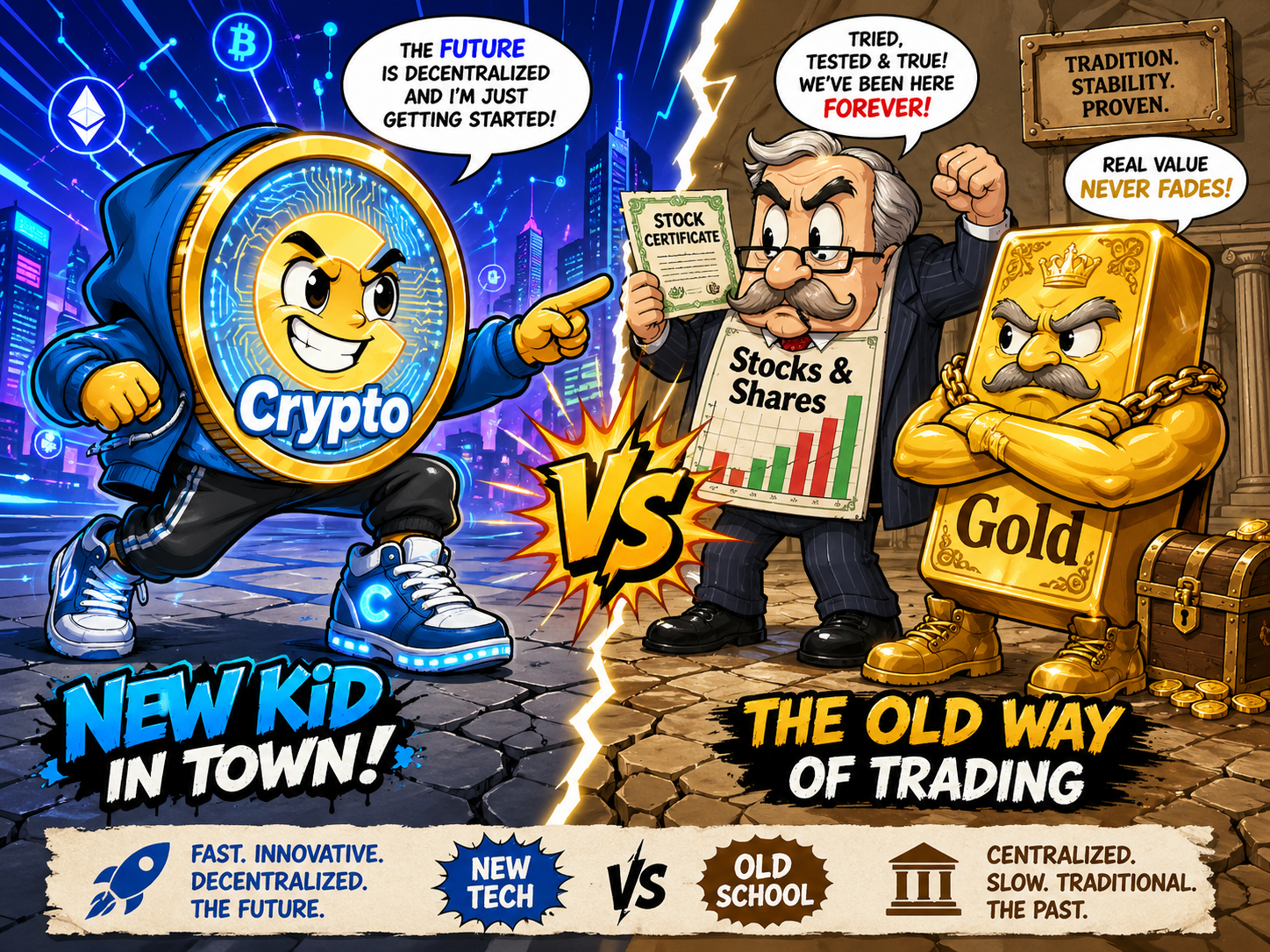
Cryptocurrency Versus Investing in Stocks, Shares, and Gold: A 10-Year Research Report, 2015–2025
I'm not an expert—just a cautious investor doing personal research.
With all the AI trading hype, I wanted some background knowledge. I've tried day trading with an AI platform with limited success.
Please use this information as a information guide only. Always consult a financial expert for investment advise.
Sample Example $1000 to invest
The real question is not simply which investment made more money, but which one helped investors build wealth they could protect, grow, and keep. That is the line I would keep returning to as a reluctant investor. It is easy to look backwards and say, “I should have bought Bitcoin,” or “I should have bought Amazon,” or “I should have held gold.”
But investing is not lived backwards. It is lived in real time, with doubt, fear, bills to pay, family responsibilities, confusing headlines, market crashes, and that uncomfortable feeling that everyone else seems to know something you do not.
If I had $1,000 to invest in 2015, I would not have been thinking like a genius investor. I would probably have been cautious, maybe even nervous.
Bitcoin still felt like something from the edge of the internet.
Amazon was already a powerful company, but its share price still looked expensive to many traditional investors.
Gold felt old-fashioned, but safe.
Looking back over the 10-year period from 2015 to 2025, these three choices tell three very different stories about risk, patience, belief, and emotional strength.
For this comparison, I looked at three possible investments:
Bitcoin, Amazon shares, and gold.
On January 2, 2015,
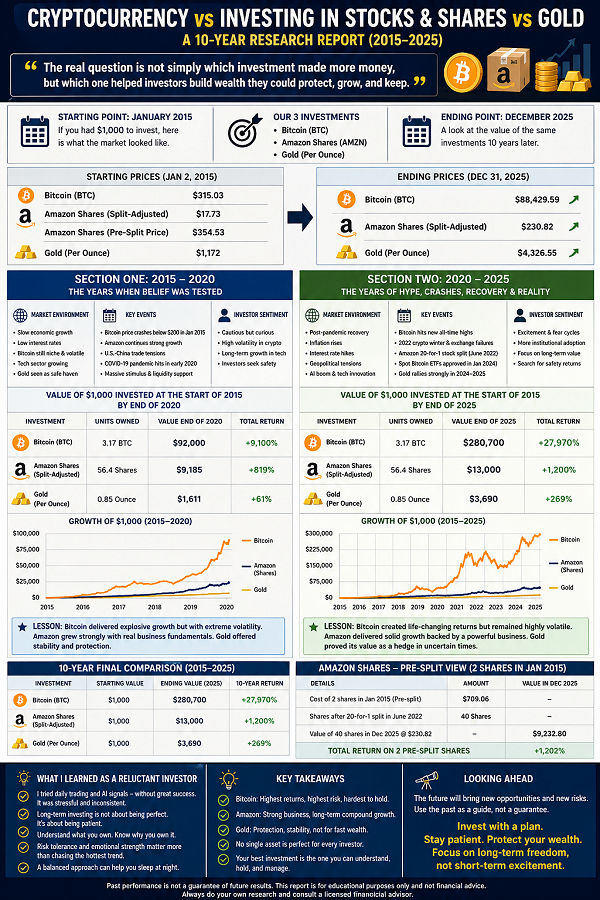
Bitcoin closed around $315.03.
Amazon’s January 2015 adjusted monthly price was about $17.73 per share, while the real pre-split price was about $354.53.
Gold’s January 2, 2015 PM fix was about $1,172 per troy ounce.
By the end of 2025,
Bitcoin was around $88,429.59 on December 31,
Amazon’s December 2025 price was about $230.82,
and spot gold was around $4,326.55 per ounce. (Yahoo Finance)
These numbers are not perfect predictions for the future, and they do not include taxes, trading fees, storage costs, bid-ask spreads, or emotional mistakes. They are a simplified “what if” calculation. But they are still useful because they show how different assets behave over time.
If $1,000 had been invested into Bitcoin at about $315.03, it would have bought roughly 3.17 Bitcoin. At about $88,429.59 by the end of 2025, that investment would have been worth approximately $280,700.
If $1,000 had been invested into Amazon at about $17.73 adjusted for its later stock split, it would have bought about 56.4 split-adjusted shares, worth roughly $13,000 by the end of 2025.
If $1,000 had been invested into gold at about $1,172 per ounce, it would have bought about 0.85 ounces, worth approximately $3,690 by the end of 2025.
2015–2020 — The Years When Belief Was Tested
From 2015 to 2020, markets were changing beneath the surface.
At the beginning of 2015, Bitcoin was not yet the global financial talking point it later became. It had already crashed from earlier highs, and in January 2015 it even fell below $200 after starting the year around $313, showing just how unstable and frightening it could be. (WIRED)
For a reluctant investor, that would have been hard to sit through. Imagine putting money into Bitcoin at the start of 2015 and almost immediately watching headlines say it was collapsing. Many people would have sold out, not because the long-term idea was wrong, but because the short-term pain was too much.
That is one of the most important lessons from Bitcoin. The return looks obvious after the fact, but the journey was not obvious while it was happening. In 2015, holding Bitcoin required belief in something that most people still doubted.
It was not backed by company earnings. It did not pay dividends. It had no customer service department. If you lost your private key, you could lose your money. If an exchange was hacked, your confidence could vanish overnight. So while the final number looks incredible, the emotional road was rough.
Amazon, by comparison, felt more understandable. People could see the boxes arriving at doors. They could understand online shopping. They could see Amazon Web Services becoming important to the internet economy.
But even Amazon was not a “safe” emotional investment. Many investors had spent years saying Amazon was overvalued. It reinvested heavily, often prioritizing growth over traditional profits.
To a cautious person, Amazon could still feel risky because its valuation depended on future growth continuing.
Gold was the easiest to understand emotionally. It had history. It had weight. It had the image of safety. Gold did not need a password, a blockchain, or a quarterly earnings report.
But from an investment point of view, gold is different because it does not produce income. It does not grow sales. It does not invent new products. Gold simply sits there, and its value depends on what people are willing to pay for safety, scarcity, and protection against uncertainty.
By the end of 2020, the market had changed dramatically. Bitcoin closed 2020 at around $29,001.72, after a year in which it gained heavily.
Amazon’s December 2020 adjusted price was about $162.85, compared with its January 2015 adjusted price of $17.73.
Gold was also stronger by the end of 2020, with one source placing the spot gold price around $1,888 per ounce on December 31, 2020.
Investment From 2015 Approx.
Value by End of 2020 Bitcoin $92,000
Amazon shares $9,185
Gold $1,611
This first five-year period teaches a powerful lesson. Bitcoin delivered the most dramatic growth, but it also demanded the strongest stomach. Amazon delivered excellent growth through business expansion, technology dominance, and consumer behavior changes. Gold protected value and grew steadily, but it did not come close to matching the explosive returns of Bitcoin or Amazon.
If I were the reluctant investor in this story, 2020 would have been the year I realized something important: avoiding risk completely can also be risky.
Keeping money only in cash may feel safe, but it can miss major wealth-building opportunities. At the same time, chasing every exciting trend can be dangerous.
The problem is not investing itself. The problem is investing without understanding what kind of risk you are taking.

2020–2025 — The Years of Hype, Crashes,
Recovery, and Reality
The period from 2020 to 2025 was very different from 2015 to 2020. The first half of the decade was about discovery and growth. The second half was about excess, fear, correction, and maturity. Bitcoin became impossible to ignore.
It went through another huge boom, attracted institutional attention, became part of mainstream financial conversation, and eventually benefited from the approval of spot Bitcoin exchange-traded products in the United States in January 2024.
That approval gave investors a more traditional way to gain exposure to Bitcoin through brokerage accounts, without directly holding coins or managing private keys. (CoinMarketCap)
But Bitcoin also reminded investors that popularity does not remove volatility. In 2025, Bitcoin reached very high levels, but it also suffered sharp corrections. Reports in late 2025 described Bitcoin hitting records above $126,000 before falling sharply toward the end of the year, showing that even after a decade of growth, it remained a highly emotional and unstable asset. (The Guardian)
Amazon’s story from 2020 to 2025 was more grounded, but still not smooth. Amazon benefited from e-commerce growth, cloud computing, digital services, and the broader technology boom. But it also faced rising costs, competition, valuation pressure, and the 2022 technology stock downturn. Its 20-for-1 stock split in 2022 made the share price look more accessible, but a split itself does not create wealth; it simply divides the same ownership into more shares.
Gold had a surprisingly strong second half of the decade. For years, many younger investors ignored gold, seeing it as old-fashioned compared with crypto or tech stocks. But by 2025, gold had a powerful rally. Reuters reported that gold gained about 65% in 2025, helped by interest-rate expectations, geopolitical tension, central-bank buying, and ETF inflows.
That matters because it shows gold still has a role when investors become worried about currencies, debt, conflict, inflation, or financial instability
This second five-year period also says a lot about daily trading and AI trading. I understand the temptation. AI trading sounds modern, fast, and intelligent. It suggests that the machine can see patterns we cannot. But for many ordinary investors, daily trading becomes stressful and inconsistent. It can turn investing into a slot machine with charts.
Instead of building wealth patiently, the investor starts reacting constantly. Every red candle feels personal. Every missed trade feels like failure. Every online success story creates pressure.
After trying daily trading with AI and not having great success, I would not see that as failure. I would see it as information. It may simply mean that short-term trading is not the right match for my temperament. Some people are built for fast markets.
Others are bettesuited to patient investing. There is no shame in being the second type. In fact, many long-term investors succeed precisely because they stop trying to outsmart every daily move.
By the end of 2025, the comparison becomes almost unbelievable.
Bitcoin was the runaway winner in pure dollar terms.
Amazon was a strong second.
Gold was the most conservative but still meaningful.
But the deeper question remains: could I have held the winner?
That is where investing becomes personal.
A spreadsheet says Bitcoin turned $1,000 into around $280,700. But a real person had to survive the crashes, hacks, bad headlines, regulatory fears, online arguments, exchange failures, and the temptation to sell after every major gain.
A spreadsheet says Amazon turned $1,000 into about $13,000.
But a real person had to hold through market corrections, valuation worries, and years when the stock looked too expensive.
A spreadsheet says gold turned $1,000 into about $3,690. But a real person had to accept slower growth while watching crypto and tech investors brag about faster gains.
That is why the best investment is not always the one with the highest return. The best investment may be the one a person can understand, hold, and manage without destroying their peace of mind.
For a reluctant investor looking toward the future, the lesson from 2015 to 2025 is not to blindly chase the next Bitcoin. It is to build a structure.
Bitcoin shows the power of asymmetric upside, where a small investment can become life-changing if the asset survives and grows.
Amazon shows the power of owning a strong business over time.
Gold shows the power of protection when uncertainty rises.
A sensible future-looking investor might not need to choose only one. A balanced approach could use stocks and shares as the foundation, because businesses create earnings and long-term economic value. It could use a smaller amount of cryptocurrency for higher-risk growth potential. It could use gold as a defensive asset, not necessarily to become rich quickly, but to provide stability during uncertain periods.
If I were writing this from my own reluctant-investor point of view, I would say this: I no longer want to gamble on every new market trend. I do not want to be pulled into every AI trading signal, every crypto coin, every hot stock, or every online prediction. I want to understand what I own. I want to know why I own it. I want to be able to sleep when the market falls. And I want my investing plan to survive my emotions.
Past performance can guide future thinking, but it cannot promise future profits. Bitcoin may not repeat its 2015–2025 performance. Amazon may not grow at the same pace forever. Gold may rise further, or it may cool if fear leaves the market. The future will not copy the past exactly. But the past does reveal patterns of behavior.
The aggressive investor was rewarded most by Bitcoin. The growth investor was rewarded well by Amazon. The defensive investor was rewarded more modestly by gold. The impatient trader may have struggled despite having advanced tools. The patient holder, however, had time on their side.
So if I had started with $1,000 in 2015, the lesson would not simply be that I should have picked Bitcoin. The lesson would be that wealth is built by matching opportunity with patience. Bitcoin gave the biggest opportunity. Amazon gave business-backed growth. Gold gave protection. But the investor still needed discipline.
That brings me back to the opening line:
The real question is not simply which investment made more money, but which one helped investors build wealth they could protect, grow, and keep.
For me, the answer is not found in one asset alone. It is found in building a calmer, wiser relationship with risk — one where I stop chasing every daily trade and start thinking like an owner of my future.
Private Policy
© Copyright 2026
https://www.jwdirectsales.com
Please be advised that some of the links in this content are affiliate links, and at no additional cost to you, I may earn a commission if you decide to make a purchase after clicking any link. I only recommend products or services I believe will add value to my readers. Please understand the decision to purchase based on these links is entirely at your discretion.